
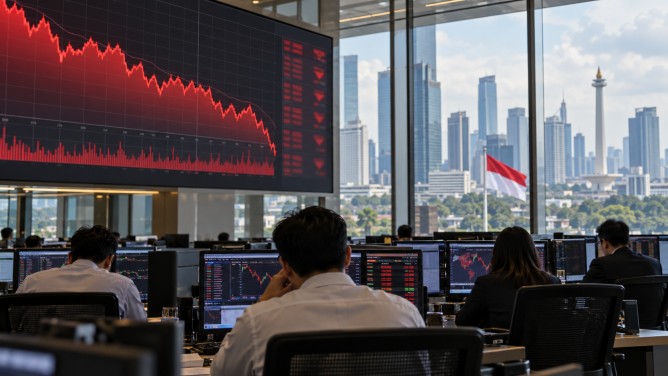
Indonesia’s stock market experienced a significant decline on Thursday, with the Jakarta Composite Index (JCI) falling 1.51% to 5,247 points. This drop comes as investors navigate domestic monetary measures alongside ongoing global economic uncertainties. The JCI fluctuated between 5,185 and 5,350 points during early trading, reflecting the market’s volatility.
The decline occurred despite Bank Indonesia’s efforts to enhance liquidity in the banking system. The central bank maintained its benchmark interest rate at 5.75% and the lending facility rate at 6.5%, while increasing the deposit facility rate by 25 basis points to 5%. Additionally, Bank Indonesia announced plans to reduce the average reserve requirement for conventional commercial banks from 9% to 7% in two stages, starting with a reduction to 8% on November 1, 2026, followed by a further decrease to 7% on December 1.
Despite these measures, the market saw widespread losses, with 519 stocks declining, 54 advancing, and 106 remaining unchanged. Approximately 1.22 billion shares were traded across 76,140 transactions, totaling a value of Rp 582.44 billion. The downturn in Indonesian stocks coincides with losses in other Asian markets, including Japan’s Nikkei 225, South Korea’s Kospi, Hong Kong’s Hang Seng, and Shanghai’s SSE Composite, all of which opened lower.
International factors continue to weigh heavily on market sentiment, with persistent inflation pressures and uncertainties about future economic conditions contributing to investor caution. Nevertheless, Indonesian stocks did attract some international interest following a speech by President Prabowo Subianto. In response, the US-listed iShares MSCI Indonesia ETF gained around 2%, although analysts urge caution, noting that a single session of gains does not necessarily indicate a sustained recovery.