
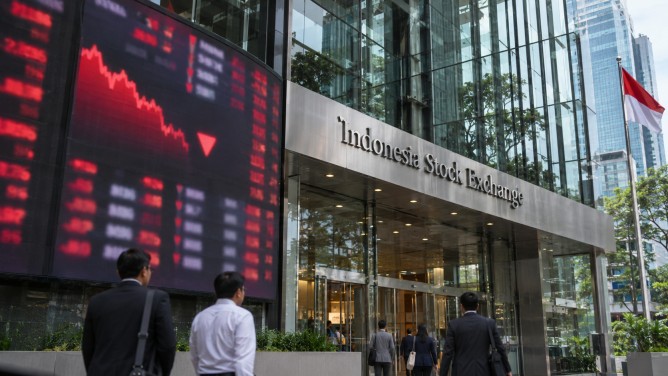
Indonesia’s stock market took a significant hit on Tuesday as the Jakarta Composite Index (JCI) fell by 3.78% to 4,904 points. The decline was largely driven by a sell-off from foreign investors and looming concerns about the upcoming MSCI index review, which could impact the inclusion and weighting of Indonesian stocks in global investment indexes.
The market downturn was widespread, with 624 stocks declining compared to just 57 advancing and 37 remaining unchanged. Trading volume was substantial, reaching 27.15 billion shares, with transactions valued at Rp 11.72 trillion (approximately $645 million). During the first trading session, foreign investors recorded net sales of Rp 831.5 billion, adding to the market’s downward pressure.
Investors are cautious ahead of the MSCI Index Review scheduled for November 11–12, which could have significant ramifications for Indonesian stocks. Additionally, the market is closely watching a meeting of Indonesia’s Financial System Stability Committee, expected to address issues such as stock market volatility, the weakening rupiah, and broader financial stability.
Domestic economic factors also contributed to the negative market sentiment. Food inflation rose to 5.81% in October from 5.03% in September, partly due to supply disruptions linked to El Niño-related weather conditions. Meanwhile, core inflation eased to 2.56% from 2.84%, raising concerns about weaker household spending, particularly among lower- and middle-income consumers.
Regional market weakness and uncertainty surrounding global technology investments further weighed on investor confidence. Concerns over rising costs and uncertain returns from artificial intelligence development triggered selling pressure across several Asian markets, adding to the challenges facing the Indonesian stock market.